

🌾 The Accelerators: Spring 2026 Edition | Focus: Data, Soil, and Sovereignty
USDA Announces America First Trade Promotion Program (AFTPP) Awardees
The America First Trade Promotion Program (AFTPP) is a strategic initiative by the USDA’s Foreign Agricultural Service (FAS) designed to bolster the global competitiveness of American agriculture. It acts as a bridge to ensure U.S. farmers and producers maintain strong export markets and build momentum for future long-term funding.
Key Takeaways
Financial Injection: The program provides immediate investment into market development. This serves as a precursor to an additional $285 million in annual supplemental funding slated to begin in fiscal year 2027 via the Working Families Tax Cuts.
Strategic Partnerships: FAS is allocating funds to 55 nonprofit organizations and cooperatives. These partnerships are intended to help exporters maintain existing relationships and build trust with international trading partners.
Flagship Program Support: The AFTPP specifically complements existing flagship market development efforts, such as the Market Access Program (MAP) and the Foreign Market Development (FMD) Program.
Primary Objective: The core focus is to capitalize on negotiated trade agreements, ensuring that high-quality U.S. products—from cattle to crops—can reach new and existing global markets effectively.
Conclusion
The AFTPP represents a proactive effort by the USDA to keep American agriculture "competitive, resilient, and ready." By providing a financial bridge today, the USDA aims to solidify the U.S. position in the global marketplace, ensuring that the infrastructure for agricultural exports is robust and well-funded before the larger 2027 fiscal expansions take effect.
For more details, you can view the official announcement on the USDA Foreign Agricultural Service website.
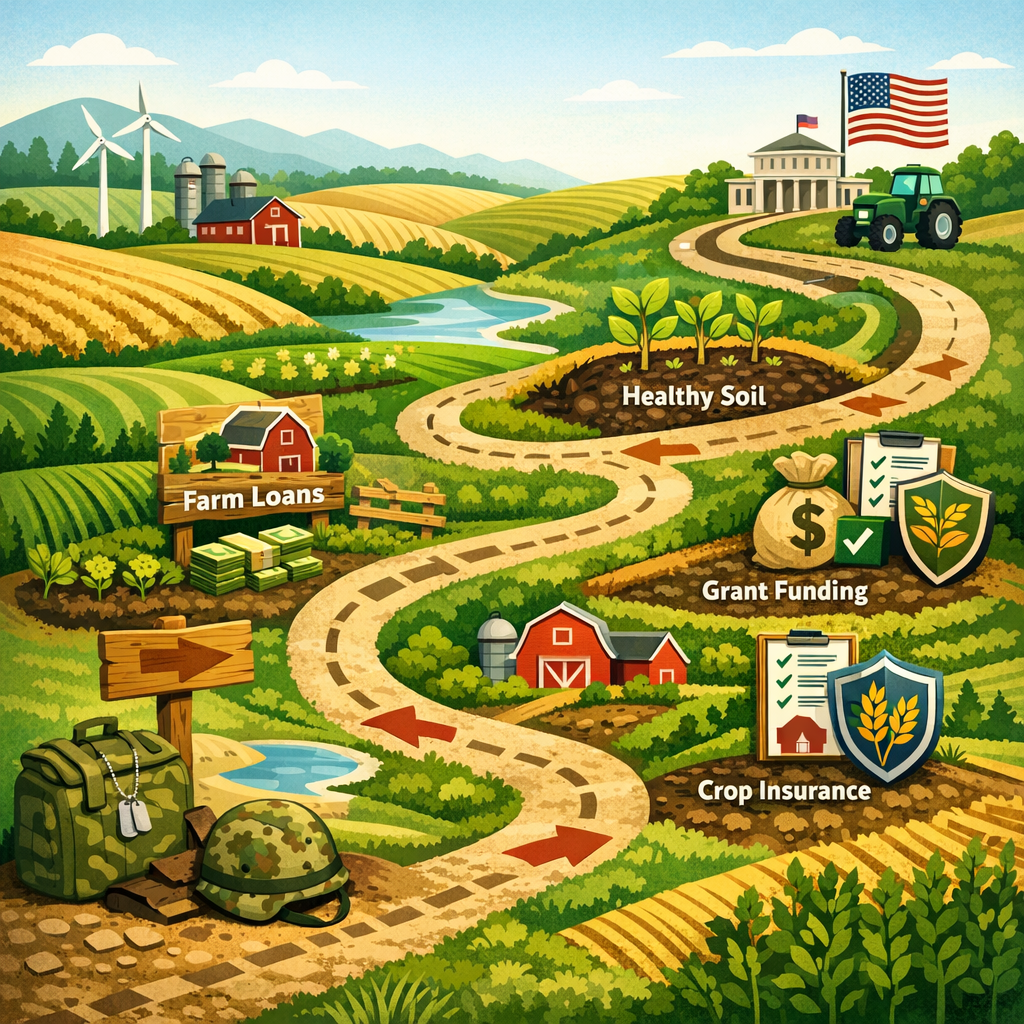
From Service to Soil by ChatGPT
From Service to Soil: Your Veterans’ USDA Beginning Farmer and Rancher Roadmap
Key Takeaways
Purpose: A free series designed to help military veterans and transitioning service members navigate USDA programs and start careers in production agriculture.
Program Scope: Covers essential resources from the Farm Service Agency (FSA), Natural Resources Conservation Service (NRCS), Rural Development (RD), and the Risk Management Agency (RMA).
Format: Hosted online via Microsoft Teams.
Upcoming Events
DateTime (Eastern)Topics & AgenciesTuesday, April 212:00 – 4:30 p.m.
• Farm Loan Programs (FSA)
• Regenerating Land, Empowering Veterans (NRCS)
Wednesday, April 222:00 – 4:00 p.m.
• Value-Added Producer Grants (RD)
• Beginners Guide to Crop Insurance (RMA)
Public Service Announcements (PSAs)
Non-Discrimination: The USDA is an equal opportunity provider. If you need to file a discrimination complaint, you can contact the Office of the Assistant Secretary for Civil Rights at (866) 632-9992.
Farmer Resources: For comprehensive tools and local service center locators, visit Farmers.gov.
Subscription Management: You can update your communication preferences or seek technical assistance through the Subscriber Services Help portal.
🌿National Farm Security: A New Frontier
Strategic Partnership: USDA & Department of War
To safeguard the American food supply, the USDA has entered into a historic Memorandum of Understanding (MOU) with the Department of War. This partnership activates the National Farm Security Action Plan, treating agricultural infrastructure as a matter of high-level national defense.
Cyber-Defense for Ag-Tech: Focused protection for automated irrigation, GPS-guided machinery, and digital grain storage sensors.
Supply Chain Sovereignty: Counteracting foreign threats to the domestic production and distribution of fertilizer and seed.
Infrastructure Resilience: Hardening the grid against disruptions that threaten livestock climate control and refrigeration systems.
📑Navigating the "One Big Beautiful Bill" Tax Reforms
Event Date: March 26, 2026
Webinar Summary: Farm Income Averaging (Schedule J)
In the wake of recent legislative shifts, the March 26 webinar provided a critical roadmap for producers looking to manage the volatility of 2026 farm sector profits. With average net cash farm income forecast to rise 18.7% this year, many producers risk being pushed into higher tax brackets.
Key Takeaways for Producers:
The "Fill the Gap" Strategy: Farm Income Averaging (Schedule J) allows you to move current-year income back into the lower tax brackets of the previous three "base years." If you had low income in 2023–2025, you can "fill" those unused brackets to avoid the 2026 progressive rate spikes.
New 2026 Exemptions: Under new reforms, estate and gifting exemptions have increased to $15 million ($30M for married couples), simplifying succession planning for generational farms.
Flexible Capital Gains: Farmers selling land to qualified buyers can now stretch capital gains taxes over four annual installments, easing the liquidity pressure of large transactions.
Accelerated Reinvestment: The webinar highlighted that 100% Bonus Depreciation remains a powerful tool for those purchasing major equipment like tractors or grain bins, allowing for a full deduction in the year of purchase.
The "Retiring Farmer" Advantage: Income averaging isn't just for active years; it is a vital tool for retiring farmers disposing of assets to prevent a massive tax hit in their final year of operation.
Pro-Tip: You are not required to average all your income. Your tax preparer should elect only the specific amount of "Elected Farm Income" that maximizes your savings based on your specific 3-year history.
USDA Support: Standing By Producers Through Disaster Recovery
In the wake of recent wildfires and winter storms, Farmers.gov has reaffirmed its commitment to helping agricultural producers recover from devastating losses. Natural disasters have taken a significant toll on farms, ranches, and rural communities—impacting livestock, crops, and essential infrastructure.
Available Assistance
The USDA is prioritizing the delivery of:
Technical Support: Guidance on navigating recovery steps and land management.
Financial Assistance: Programs designed to help generational family operations get back on their feet and protect their livelihoods.
Resources for Producers
If you have been affected by recent weather events or wildfires, you can find more information and local contact details through the following official channels:
Visit the Portal:Farmers.gov
Get Direct Help: Contact USDA
Full Update: View the official message online
USDA is an equal opportunity provider, employer, and lender.
Key Highlights:
Disaster Recovery Support: The USDA is prioritizing the delivery of technical and financial assistance to help farmers and ranchers get back on their feet after devastating crop and livestock losses.
Impact on Rural Communities: The update acknowledges the severe toll these events take on infrastructure, livelihoods, and generational family operations.
Equal Opportunity: Assistance is provided through a framework of equal opportunity, with clear paths for producers to file for support or seek discrimination complaints if necessary.
Official Resources to Include:
Main Portal: Farmers.gov
Contact Information: USDA Contact Us Page
Web Version of Update: View the full message online
Would you like me to draft a specific "News" blurb or a social media post based on this summary?
Agricultural Lifeline: New Financial Assistance & Relief Programs for 2026
Based on recent updates from Farmers.gov and the USDA, there are several active financial assistance and relief programs available for agricultural producers:
Disaster Recovery & Risk Management
Federal Crop Insurance & NAP: Producers with Federal Crop Insurance or Noninsured Crop Disaster Assistance Program (NAP) coverage must report storm or weather-related losses to their agent or local FSA office within 72 hours of discovery.
Livestock & Tree Assistance: Programs like the Livestock Indemnity Program, Emergency Assistance for Livestock, Honeybees, and Farm-raised Fish, and the Tree Assistance Program provide relief for specific agricultural losses.
Land Recovery: The Emergency Conservation Program and Emergency Forest Restoration Program help with land and forest recovery following natural disasters.
Loans & Financial Support
Emergency Loans: Low-interest emergency loans are available for producers in designated disaster areas to help recover from production and physical losses.
Direct & Guaranteed Farm Loans: These loans assist producers who are unable to secure commercial financing for replacing property, equipment, or covering living expenses.
Rural Housing Modernization: The Single Family Housing Guaranteed Loan Program and Single Family Housing Direct Loan Program have been upgraded to speed up access to credit for rural homeownership.
Competitive Grants & Research Funding
Rapid Response Grants: A new AFRI Rapid Response program offers up to $500,000 to quickly address emerging pest and disease threats.
Organic Agriculture (OREI): The Organic Agriculture Research and Extension Initiative has an estimated $65 million in funding available with an application deadline of May 14, 2026.
Education & Workforce Development: Various AFRI grant opportunities are available for professional development in agricultural literacy and community college training.
Market Expansion & Infrastructure
"Product of USA" Labeling: A new voluntary labeling standard went into effect on January 1, 2026, requiring animals to be born, raised, harvested, and processed in the U.S. to carry the label.
Market Promotion: Over $212 million was awarded through the Market Access Program (MAP) and Foreign Market Development (FMD) program to expand global export markets.
Local Agriculture Market Program (LAMP): Over $26.8 million has been awarded to 87 projects to connect farmers with local consumers and institutional markets.
Timber Production: A $115.2 million investment was announced to expand timber production and wood processing in eight states.
Innovation & Modernization
“One Farmer, One File”: A new initiative designed to streamline USDA interactions by creating a single digital record for producers, reducing red tape and accelerating fund delivery.
Rural Housing Modernization: New efforts to speed up access to credit and lower burdens for rural borrowers through the My RD Loan Portal.
Research Security: The USDA and Department of War signed an MOU to strengthen the National Farm Security Action Plan, focusing on protecting the agricultural supply chain from foreign threats and cyberattacks.
🌿65 Million for Organic Innovation: Are You Ready?
The 2026 Organic Agriculture Research and Extension Initiative (OREI) is officially open! Whether you are a researcher, a farmer-led organization, or a rural innovator, this is your window to secure funding for the future of sustainable agriculture.
What’s on the table?
Full Research & Extension: Up to $3.5 Million for large-scale impact.
Planning & Workshops: $50k - $75k to get your big idea off the ground.
Rapid Response: Critical support for emerging pest and disease threats.
⚠️ The "New for 2026" Catch: The USDA has moved to the new eRA Commons system. If you aren't registered yet, you need to start now to meet the May deadline.
Get the full breakdown, submission links, and our "One Farmer, One File" guide in the latest edition of The Accelerators.
👇 Read the Full Update & Access Application Links: LEARN MORE & APPLY
#AgTech #OrganicFarming #USDAGrants #SustainableAg #TheAccelerators #RuralDevelopment #SiliconHeartland

The Global Roundup by ChatGPT
Global Agricultural International Network Spotlight: Guatemala’s Sugar Sector Hits New Heights
Guatemala continues to solidify its position as a global powerhouse in the sugar industry. According to the latest Guatemala: Sugar Annual report, the country is on track for significant expansion in the 2026/27 marketing year.
Driven by an increase in harvested area to 262,000 hectares, production is forecast to reach a staggering 2.821 million metric tons. What makes this growth particularly notable is the industry's shift toward high-value exports; refined sugar now accounts for roughly 70% of total exports. As one of the world's top three most efficient producers, Guatemala is successfully balancing this industrial scaling with aggressive sustainability initiatives, ensuring it remains a dominant and responsible player in the international market.
关键提要 Key Takeaways:
Guatemala Sugar Report
Production Forecast: Expected to reach 2.821 million metric tons for the 2026/27 season.
Efficiency Leader: Guatemala remains ranked as one of the top three most efficient sugar producers globally.
Refined Focus: The export mix has shifted heavily toward value-added products, with refined sugar now comprising 70% of exports.
Export Volume: Total exports are estimated to hit 1.685 million metric tons, serving a diverse array of global markets.
Sustainability: The sector is doubling down on sustainability initiatives to maintain long-term viability and market access.
Global Agricultural Highlights (April 14, 2026)
🌏 Asia Market & Policy Updates
China Food Registration: A new risk assessment report (referencing WTO notification G/TBT/N/CHN/1964/Add.2) has been introduced to justify China's regulatory framework for the registration of overseas food manufacturers.
China Pet Food: The market reached $43.4 billion in 2025. Growth is shifting toward high-value, functional, and nutritional products, driven by younger consumers and robust online sales.
South Korea Grain: U.S. corn exports remain strong for the 2026/27 marketing year due to competitive pricing. Notably, South Korea resumed U.S. table rice auctions on March 6, 2026.
Vietnam Regulatory Shifts: Vietnam has suspended Decree 46 (which had disrupted food trade) in favor of the existing Decree 15 until a new Food Safety Law is enacted. Additionally, a new Minister of Agriculture and Environment, Mr. Trịnh Việt Hùng, has been appointed.
Hong Kong Promotion: A USA Pavilion is being organized for the Hong Kong Food Expo PRO (August 13-15, 2026), offering discounted booth space for U.S. companies.
The Livestock Ledger: Consolidation, Competition, and Canadian Growth
Accoding to the Global Agricultural International Network - GAIN reports email, here are the key takeaways for the livestock sector and a summary of the other global reports:
Key Takeaways: Canadian Livestock
Herd Rebuilding Strategy: The cattle industry is moving from contraction to a consolidation phase, prioritizing heifer retention to grow the breeding herd for the first time in years.
Production Growth: Both beef and pork sectors are expected to see increased slaughter and production in 2026, driven by larger calf/pig crops and better processing efficiency.
Export Optimism: Strong global demand and new market access are expected to keep Canadian beef and pork exports on an upward trajectory.
Summary of Other Global Reports
China: Trade & Market Access
Seafood: China lifted the 25% additional tariff on Canadian lobsters and snow crabs (now at 7%), giving Canada a significant price advantage over the U.S., which still faces a 17% tariff.
Food Processing: China remains the world’s second-largest agricultural importer. While U.S. consumer exports dropped 30% in 2025 due to trade tensions, products like dairy and distilled spirits remain resilient.
Trade Shows: U.S. exporters projected $10 million in sales following the FHC 2025 show in Shanghai.
Emerging Market Opportunities
Colombia & Dominican Republic: Both nations show growing demand for U.S. food ingredients. In Colombia, there is a specific shift toward "healthy" ingredients like oilseed meals and fruit flours, while the Dominican Republic is seeing growth in private-label supermarket goods.
Ethiopia: Wheat production is forecast to rise 8% due to expanded irrigation and mechanization, though 1.4 million metric tons of imports are still needed to meet demand.
Indonesia: A potential El Niño is causing farmers to switch from rice to corn (which uses less water). Wheat imports are expected to rise to support a growing poultry sector.
Japan: The food processing sector contracted slightly (3%), but demand is shifting toward functional health foods and frozen/convenience products.
Nigeria: The government is launching a National Livestock Growth Acceleration Strategy to integrate its agri-food systems with international trade.
Regulatory Updates
India: New definitions for food packaging regulations have been proposed to the WTO; stakeholders have until May 22, 2026, to comment.
Market Alert: Canada’s Strategic Lobster Advantage in China
The landscape of the Chinese luxury seafood market has shifted dramatically. As of March 1, 2026, Canadian exporters have secured a decisive price advantage that fundamentally changes the competitive dynamic for North American lobster.
The Strategic Shift
China has lifted the 25% additional tariff on Canadian lobster and snow crab. This reduction brings the effective import tariff for Canadian products down to 7%.
Key Competitive Advantages
The 10% Price Gap: While Canada enjoys a 7% rate, U.S. lobster remains subject to a 17% effective tariff. This gap allows Canadian suppliers to undercut U.S. competitors on price while maintaining healthier margins.
Tier-2 Market Penetration: Lower landed costs enable Canadian brands to move beyond the saturated luxury hubs of Shanghai and Beijing, targeting price-sensitive but growing middle-class demand in Tier-2 cities.
Securing Long-Term Loyalty: As U.S. supply becomes less cost-effective, Canadian exporters have a window to displace long-standing U.S. contracts in the hospitality and e-commerce sectors, establishing brand dominance that will be difficult to reverse.
GAIN report snapshot: Argentina and Ecuador
The latest April 9, 2026 Global Agricultural Information Network (GAIN) updates point to two important themes in global agriculture: stronger oilseed momentum in Argentina and continued import dependence paired with grain recovery in Ecuador.
In Argentina, the outlook remains centered on export strength. Soybean production for MY 2026/27 is projected at 49 million metric tons, with yields returning to more typical levels after a particularly strong current season. While soybean crush is expected to ease slightly to 42 million metric tons as margins soften, soymeal exports are still forecast to remain strong at 30 million metric tons. Sunflower acreage is also expected to expand sharply, rising about 14 percent to 3.3 million hectares, continuing a multi-year growth trend. Peanut production is projected to recover to 1.5 million metric tons, though exports may soften due to weaker demand. The broader signal is clear: Argentina’s oilseed sector remains highly export-oriented, supported by steady global vegetable oil demand.
In Ecuador, the story is different. Wheat production for MY 2026/27 is projected at just 9,000 metric tons, underscoring the country’s continued reliance on imports to meet domestic demand. Corn, however, is forecast to rebound significantly, reaching 1.80 million metric tons, a 28 percent increase over the prior year thanks to expanded harvested area and better yields. Rice production is projected at 1.5 million metric tons, with planted area holding steady at 280,000 hectares. Together, these figures show a mixed picture: stronger domestic corn performance, steady rice output, and ongoing structural dependence on imported wheat.
Key takeaways
Argentina remains a major oilseed export engine. Soybeans, soymeal, soybean oil, and sunflower expansion all reinforce the country’s global importance in oilseed and vegetable oil markets.
Global vegetable oil demand is still a major driver. Even with slightly softer crushing margins, Argentina’s soybean oil and broader oilseed sector outlook remains stable.
Sunflower is gaining momentum. Argentina’s expected 14 percent acreage increase signals continued confidence in sunflower as a competitive crop.
Ecuador’s wheat gap remains unchanged. Domestic wheat production is too small to meet national demand, keeping the country fully dependent on imports.
Corn is Ecuador’s growth story. A 28 percent production jump suggests improving domestic grain capacity and stronger near-term supply prospects.
Rice is steady, not surging. Ecuador’s rice sector appears stable, with production and planted area essentially holding firm.
These GAIN updates highlight how global agriculture is being shaped by both export-led growth and import vulnerability: Argentina is leaning into its role as a global oilseed supplier, while Ecuador continues balancing domestic production gains with structural food import needs.
If you want, I can also turn this into a shorter newsletter blurb or a more polished “What this means” section for ag and rural economic development readers.
What this means
For agriculture and rural economic development readers, these updates are more than commodity statistics. They show how different countries are positioning themselves inside a changing global food and trade system.
Argentina’s outlook reinforces the power of value-added agriculture. The country is not only producing soybeans and sunflowers at scale; it is also sustaining its role as a major processor and exporter of soymeal and soybean oil. That matters because rural economic strength often comes not just from growing crops, but from building the infrastructure, logistics, and processing capacity that allow regions to capture more value before products leave the country.
Ecuador’s outlook highlights the importance of production resilience and food system balance. Its continued dependence on imported wheat shows the vulnerability that can come when domestic production is too limited to meet demand. At the same time, the projected rebound in corn demonstrates how improved yields and expanded harvested area can strengthen local supply and reduce pressure on the broader system. For rural communities, that is a reminder that productivity gains still matter, especially when tied to food security and market stability.
There is also a broader lesson here for rural regions everywhere: diversification matters. Argentina’s expansion in sunflowers and recovery in peanuts suggest the value of not relying too heavily on a single crop alone. Ecuador’s mixed outlook across wheat, corn, and rice shows why regional economies benefit when multiple crops and supply channels are part of the strategy.
For rural economic development leaders, these reports point to three practical takeaways. First, competitive advantage increasingly comes from connecting production to processing, trade, and export readiness. Second, food security depends not only on imports, but on whether local systems can expand output where conditions allow. Third, rural strategy works best when it combines productivity, diversification, and infrastructure rather than focusing on acreage alone.
In short, these GAIN updates remind us that agriculture is not just about harvest volume. It is about how regions build resilience, create value, and position rural communities to compete in a global market while protecting local stability.
Market Pulse: The 2026 Outlook for Berries and Grains
Stay informed with the latest insights and developments from the USDA Foreign Agricultural Service (FAS). This roundup summarizes recent Global Agricultural Information Network (GAIN) reports and significant policy announcements shaping international trade.
Strategic Market Opportunities
India’s Food Processing Boom: India's food processing sector is projected to grow to $535 billion by 2026. This rapid expansion, driven by urban consumption and e-commerce, offers significant opportunities for U.S. exporters of high-quality, specialized ingredients.
Specialty Crops in Botswana: Botswana presents strong prospects for U.S. exports of premium products like onions, live plants, and bovine meat, particularly to affluent consumers in Gaborone.
Germany’s Nut & Dried Fruit Market: As Europe’s largest market for these products, Germany remains a critical destination for U.S. almonds, pistachios, and walnuts.
Regional Production & Trade Updates
Brazil’s Record Exports: Brazil continues its dominance as a leading beef and poultry exporter. While beef slaughter may decrease in 2026 due to the cattle cycle, pork production and exports are expected to reach record highs.
Ukraine’s Resilient Recovery: Despite the ongoing conflict, Ukraine’s retail industry and food imports have largely returned to pre-war levels, with increasing demand for U.S. seafood, nuts, and pet food.
Mexico’s Leading Produce: Mexico remains the global leader in avocado production, with 2026 output forecast to reach 2.8 million metric tons. It also stays the top supplier of fresh berries to the U.S..
Policy, Regulation & Funding
New Specialty Crop Assistance: The USDA announced $1 billion in assistance for specialty crop farmers impacted by unfair market disruptions and inflation. The deadline for 2025 acreage reporting was March 13, 2026.
Funding for Market Promotion: The FAS announced funding for three $115,000 marketing tours designed to increase U.S. exports of distilled spirits and soy to Uzbekistan and Armenia. Applications are open until May 14, 2026.
International Regulatory Changes:
China: Notified the WTO of new draft food safety standards for prepared dishes and introduced lower VAT rates (9%) for products like sunflower and rapeseed oil.
European Union: Authorized two new genetically engineered crops (maize and sugar beet) for import and extended the suspension of retaliatory tariffs on U.S. products until August 2026.
Taiwan: Clarified BSE import restrictions, ensuring no changes to current U.S. beef exports, and extended tax cuts for imported commodities like wheat and corn through September 2026.
Recent Investigations
Trade Fraud Prevention: USDA Inspector General John Walk recently visited Miami to reaffirm the OIG’s commitment to combating agricultural trade fraud, including smuggling and counterfeit labeling.
Would you like me to draft a summary for a specific country or commodity from these reports?
Based on the latest reports from the USDA Foreign Agricultural Service (FAS), here are the strategic summaries for India’s Food Processing Ingredients and Mexico’s Avocado and Berry sectors.
1. Food Processing Ingredients (India)
India's food processing sector is undergoing a massive transformation, shifting from traditional staples to high-value, processed goods.
Market Valuation: The sector is on track to grow from $355 billion (2024) to an estimated $535 billion by fiscal year 2026.
Driver of Demand: Rapid urbanization and the rise of e-commerce are fueling a need for "health-conscious" and "convenience" products.
Segment Opportunity: Approximately 32% of the total food market is now comprised of processed foods, creating a major opening for U.S. exporters of specialized functional ingredients.
Key Takeaway: For U.S. suppliers, the growth in India isn't just about volume—it’s about specialized ingredients (natural preservatives, fortifiers, and premium additives) that cater to a middle class increasingly focused on quality and food safety.
2. Fresh Fruits: Avocados & Berries (Mexico)
Mexico remains the undisputed heavyweight in the production of high-value produce, particularly for the North American market.
Avocado Dominance: Production is forecast to reach 2.8 million metric tons in 2026. Mexico currently accounts for nearly 30% of global avocado production, with the U.S. remaining its primary export destination.
Berry Expansion: Combined production of blueberries, raspberries, and strawberries is expected to grow by 4% this year.
Strategic Window: Mexican growers are aggressively planting new blueberry varieties to hit the "early spring" market window, specifically to outpace competitors from South America.
Key Takeaway: Mexico’s agricultural strategy is focused on seasonal dominance. By timing their harvests to hit the U.S. market when domestic production is low, they maintain high price points and a near-monopoly on several "superfood" categories.
Global Protein Trends: The 2026 Livestock Outlook
Here are the strategic summaries for Livestock and Sugar based on the latest USDA reports:
1. Livestock (Brazil)
Brazil remains a global powerhouse in meat production, though its sectors are moving in opposite directions due to biological and market cycles.
Pork Surge: Brazilian pork production and exports are forecast to reach record highs in 2026, driven by strong international demand and lower feed costs.
Cattle Cycle Shift: After a period of high production, Brazilian beef slaughter is expected to decrease slightly in 2026 as the industry enters a "herd rebuilding" phase.
Export Dominance: Despite the cattle cycle shift, Brazil maintains its status as a top global exporter, leveraging its massive scale to meet demand in China and other emerging markets.
Key Takeaway: While the beef market is tightening due to natural cycles, the pork sector is the primary growth engine for Brazilian exports in the coming year, offering a competitive alternative in the global protein trade.
2. Sugar (Mexico)
Mexico’s sugar industry is a critical component of its trade relationship with the U.S., but it faces significant climate and regulatory challenges.
Drought Impacts: Severe weather and drought conditions in key growing regions have recently pressured production levels, leading to tighter supplies.
Trade Quotas: Mexico remains the primary supplier for the U.S. Sugar Import Quota, though its ability to meet full allocations is closely tied to its domestic recovery from weather events.
Modernization Needs: There is an increasing focus on improving mill efficiency and water management to stabilize yields against future climate volatility.
Key Takeaway: The stability of the North American sugar market heavily depends on Mexico’s weather recovery. Buyers should monitor Mexican production closely, as any shortfall directly impacts the volume available for export to the United States.
For additional information and to access the full archive of USDA Foreign Agricultural Service (FAS) reports, you can visit the official GAIN (Global Agricultural Information Network) portal.
Specific links from recent reports include:
India Food Processing Ingredients Annual Report: View PDF Report.
USDA Foreign Agricultural Service Homepage: fas.usda.gov.
Subscription Management: You can modify your report preferences or sign up for alerts on the USDA FAS Subscriber Preferences Page.
For your Livestock and Sugar summaries, here are the most direct source links to use for your website buttons or "Read More" links:
1. Livestock (Brazil)
The primary source for the Brazilian pork and beef data is the FAS GAIN Livestock and Products Semi-annual report.
Source Link:Brazil: Livestock and Products Semi-annual
2. Sugar (Mexico)
The details regarding Mexican production and drought impacts come from the FAS GAIN Sugar Annual report.
Source Link: Mexico: Sugar Annual
Summary of All Links for Continued Reading:
Commodity Region Direct Report Link
Food Processing India Download PDF
Livestock Brazil Download PDF
Sugar Mexico Download PDF
General Archive Global USDA GAIN Search Portal
Resource Center: Official Data & Reports
Access the full technical filings and global archives used in this month's brief.
Focus Area Key Strategic Insight Official Source
Livestock & Protein
Brazil’s Pork Surge & Beef Rebuilding
Sugar & Sweeteners
Mexico’s Production & Trade Recovery
Food Processing
India’s $535B Ingredients Market
Global Archive
Searchable Database for 200+ Markets
Looking for more?
Modify Your Alerts: Update your frequency and commodity interests at the USDA Subscriber Page.
Search by Country: Find specific reports for over 200 countries via the FAS Homepage.
Don’t Just Read the News—Own the Strategy
The agricultural landscape moves fast. Global trade shifts, climate volatility, and new regulations like the "Product of USA" labeling can impact your margins overnight. Stop reacting to the market and start anticipating it.
Subscribe to The Accelerators NewsletterGet monthly strategic deep-dives, regulatory alerts, and exclusive USDA report summaries delivered straight to your inbox.
Why Join Our Inner Circle?
Curated Intelligence: We distill thousands of pages of GAIN Reports into 5-minute actionable briefs.
Regulatory Foresight: Immediate updates on WTO notifications and international food safety standards before they hit the mainstream.
Direct Access: Quick-links to critical resources from the USDA Foreign Agricultural Service and Farmers.gov.